現在あちこちでJuniper JN0-650認定試験の問題集を探しているのか
Wiki Article
P.S. Tech4ExamがGoogle Driveで共有している無料かつ新しいJN0-650ダンプ:https://drive.google.com/open?id=1iDT2ZWwc5PiVc4dCgyy6ANNN0u76b7Fe
Tech4Examのシニア専門家チームはJuniperのJN0-650試験に対してトレーニング教材を研究できました。Tech4Examが提供した教材を勉強ツルとしてJuniperのJN0-650認定試験に合格するのはとても簡単です。Tech4Examも君の100%合格率を保証いたします。
Juniper JN0-650 認定試験の出題範囲:
| トピック | 出題範囲 |
|---|---|
| トピック 1 |
|
| トピック 2 |
|
| トピック 3 |
|
| トピック 4 |
|
JN0-650復習問題集、JN0-650最新受験攻略
Juniper高効率のJN0-650学習教材を使用すれば、プロの認定試験に合格した製品を使用しなかった場合に必要な時間の半分を費やすだけで済みます。 このようにして、旅行、パーティー、さらに別の試験の準備をする時間が増えます。 あなたにとってJN0-650トレーニングトレント:Tech4ExamのEnterprise Routing and Switching, Professional (JNCIP-ENT)の利点は、金銭による評価からはほど遠いものです。 一流の専門家チーム、Enterprise Routing and Switching, Professional (JNCIP-ENT)高度な学習コンセプト、完全な学習モデルがあります。 私たちの学習教材であなたのために節約された時間はJN0-650、私たちにとって最大のリターンです。
Juniper Enterprise Routing and Switching, Professional (JNCIP-ENT) 認定 JN0-650 試験問題 (Q60-Q65):
質問 # 60
Exhibit
You need to configure the non-RP routers in your network to dynamically learn the location of the RP using standard protocols only. You have already applied the configuration shown in the exhibit, but the routers have not learned the location of the RP.
Which additional step must you take to fulfill these requirements?
- A. Configure Auto-RP
- B. Configure MSDP.
- C. Configure Anycast RP.
- D. Configure BSR.
正解:D
解説:
The exhibit shows a multicast network runningPIM Sparse Modewhere R2 is configured as a local Rendezvous Point (RP). However, the non-RP routers (like R5) show no learned RP in their show pim rps output. To resolve this usingstandard protocolsfor dynamic RP discovery, you must implement a mechanism that automates the distribution of RP information across the PIM domain.
* Bootstrap Router (BSR) (Option B):BSR is the industry-standard (RFC 5059) mechanism for dynamically electing an RP and distributing that information throughout a PIM-SM domain.
* It uses two roles:Candidate-RPs (C-RPs), which announce their desire to be an RP, and Candidate-BSRs (C-BSRs), which collect these announcements and flood them to all other routers in the network via PIM bootstrap messages.
* BSR is a "standard protocol" as it is part of the PIMv2 specification. Once configured on R2 (as C-RP) and potentially R1 or R2 (as C-BSR), all other routers will dynamically learn that R2 is the RP for the specified group ranges.
* Auto-RP (Option D):While this also provides dynamic RP discovery, it is aproprietaryCisco protocol. Although Junos supports it for interoperability, the question specifically asks for "standard protocols only," making BSR the preferred choice.
* MSDP (Option A):Multicast Source Discovery Protocol (MSDP) is used to share information about active sources betweendifferentPIM domains or for Anycast-RP. It does not handle the initial discovery of an RP within a single domain for standard PIM-SM operations.
* Anycast RP (Option C):This is a technique used for RP redundancy and load balancing. While it can use BSR or MSDP for synchronization, it is a design architecture rather than a standalone "standard protocol" for the basic dynamic discovery of an RP in the manner requested here.
Configuration Example for BSR in Junos OS 24.4:To enable this, you would add the following to the RP (R2):
set protocols pim rp bootstrap-discovery
set protocols pim rp candidate-rp 10.222.1.2 group-ranges 224.0.0.0/4
set protocols pim rp candidate-bsr 10.222.1.2
質問 # 61
What is the function of a private VLAN?
- A. prevent traffic in a VLAN from leaving a switch
- B. segment a single VLAN into multiple broadcast domains
- C. prevent a user from identifying which VLAN they are in
- D. encrypt traffic between members of the same VLAN
正解:B
質問 # 62
Exhibit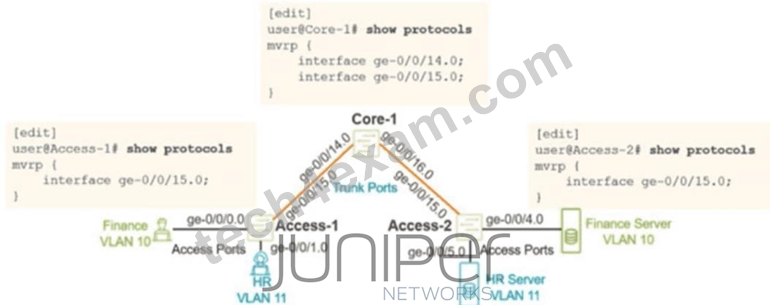
You configured MVRP in your Layer 2 network using the configuration shown in the exhibit. You verified that the appropnate VLANs are configured and applied on the two access switches. You are using RSTP as your loop prevention mechanism. Unfortunately, the users are not able to communicate with their corresponding server attached to the Access-2 switch.
In this scenario, what should you do to solve this problem?
- A. Configure VSTP instead of RSTP as your loop-prevention mechanism.
- B. Configure the ge-070716.0 interface on the Core-1 switch under MVRP.
- C. Configure the access interfaces on the Access-1 switch under MVRP.
- D. Configure the access interfaces on the Access-2 switch under MVRP.
正解:B
解説:
The exhibit shows a network topology where Multiple VLAN Registration Protocol (MVRP) is used to dynamically manage VLANs across switches Core-1, Access-1, and Access-2.
* Identifying the Missing Configuration: According to the diagram, the trunk link between Core-1 and Access-2 uses interface ge-0/0/16.0 on the Core-1 side.
* Output Analysis: However, the show protocols mvrp output for Core-1 only lists interfaces ge-0/0/14.
0 and ge-0/0/15.0.
* MVRP Requirements: For MVRP to successfully propagate VLAN information between Access-2 and the rest of the network, the protocol must be enabled on every trunk interface in the path.
* Solution: Because ge-0/0/16.0 is missing from the Core-1 MVRP configuration, VLAN registration messages from Access-2 are not being processed by Core-1. Configuring this interface under MVRP on Core-1 will solve the communication problem.
質問 # 63
Exhibit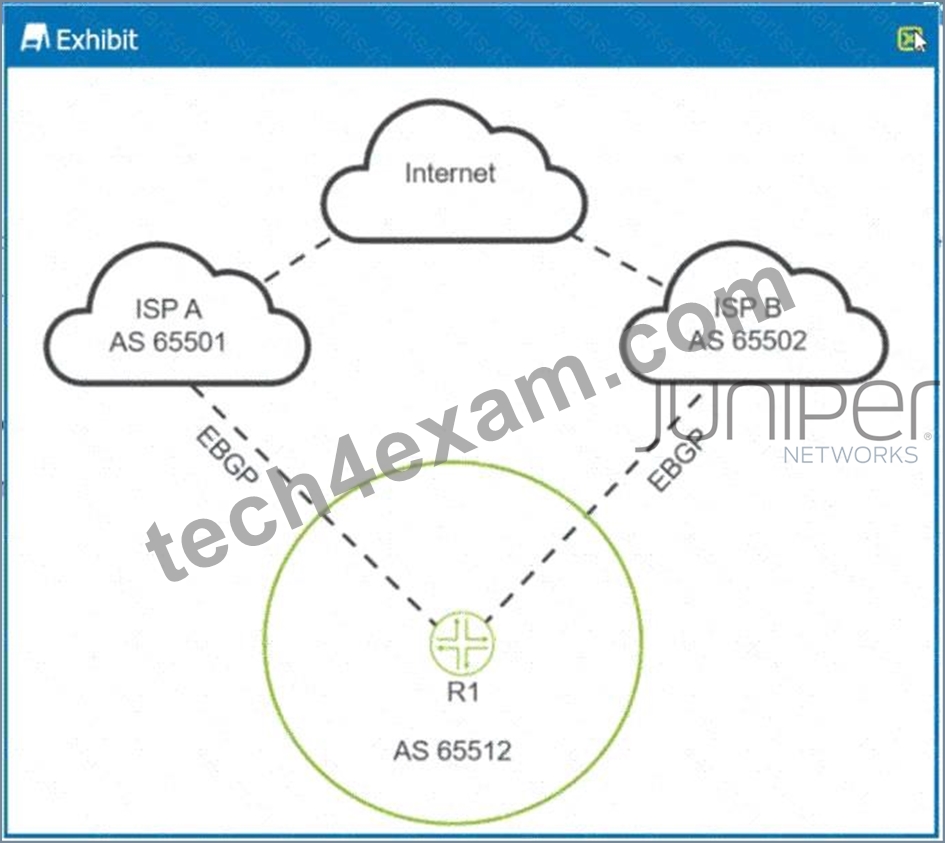
You are receiving the same BGP Internet routes on R1 from both upstream ISPs. You are asked to load- balance traffic destined to the Internet across both ISPs.
Referring to the exhibit, which BGP solution should you use?
- A. Use the prefix limit feature on R1
- B. Use the multipath multiple-as feature on R1.
- C. Use the damping feature on R1.
- D. Use the multihop feature on R1.
正解:B
解説:
In standard BGP operations, a router typically selects only one " best path " for a given destination prefix and installs that single path into the forwarding table. To utilize multiple paths for traffic forwarding (load- balancing), specific multipath features must be enabled.
BGP Multipath: This feature allows a router to install multiple equal-cost paths into the routing and forwarding tables. However, by default, BGP multipath requires that all candidate paths have the same neighboring Autonomous System (AS).
Multipath Multiple-AS (Option B): In the exhibit, R1 is receiving routes from ISP A (AS 65501) and ISP B (AS 65502). Since these are two different neighboring ASs, the standard multipath feature is not sufficient.
You must use the multipath multiple-as statement under the BGP group or neighbor hierarchy. This tells Junos to consider paths as equal even if they originate from different neighboring ASs, provided all other BGP path selection attributes (Local Preference, AS Path length, Origin, MED, etc.) are identical.
Why other options are incorrect: * Option A (multihop) is used for peering with routers that are not directly connected.
Option C (prefix limit) is a security and stability feature to limit the number of prefixes received from a neighbor.
Option D (damping) is used to penalize unstable, " flapping " routes to prevent constant routing table churn.
Configuration Example for Junos OS 24.4: To implement this on R1, you would use the following configuration:
set protocols bgp group < group-name > multipath multiple-as
質問 # 64
You must provide network connectivity to hosts that fail authentication.
In this scenario, what would be used in a network secured with 802.1X to satisfy this requirement?
- A. Use the server-reject-vlan command to specify a guest VLAN.
- B. Configure the port as a spanning tree edge port.
- C. Configure the native-vlan-id parameter on the port.
- D. Configure a secondary IP address on the port for unauthenticated hosts.
正解:A
質問 # 65
......
Tech4Examは専門的なIT認証サイトで、成功率が100パーセントです。これは多くの受験生に証明されたことです。Tech4ExamにはIT専門家が組み立てられた団体があります。彼らは受験生の皆さんの重要な利益が保障できるように専門的な知識と豊富な経験を活かして特別に適用性が強いトレーニング資料を研究します。その資料が即ちJuniperのJN0-650試験トレーニング資料で、問題集と解答に含まれていますから。
JN0-650復習問題集: https://www.tech4exam.com/JN0-650-pass-shiken.html
- Enterprise Routing and Switching, Professional (JNCIP-ENT) の試験認定 - JN0-650 資格の王道 ???? ➤ www.goshiken.com ⮘から簡単に▶ JN0-650 ◀を無料でダウンロードできますJN0-650無料模擬試験
- JN0-650模擬体験 ⚪ JN0-650受験内容 ???? JN0-650模擬試験 ???? Open Webサイト【 www.goshiken.com 】検索“ JN0-650 ”無料ダウンロードJN0-650日本語認定対策
- Enterprise Routing and Switching, Professional (JNCIP-ENT) の試験認定 - JN0-650 資格の王道 ???? “ www.jpshiken.com ”を開いて[ JN0-650 ]を検索し、試験資料を無料でダウンロードしてくださいJN0-650勉強の資料
- JN0-650テスト内容 ???? JN0-650テストトレーニング ???? JN0-650出題範囲 ???? サイト➡ www.goshiken.com ️⬅️で“ JN0-650 ”問題集をダウンロードJN0-650模擬試験
- JN0-650 試験内容 Enterprise Routing and Switching, Professional (JNCIP-ENT) 対策方法を徹底解説 ???? ⏩ www.copyright.jp ⏪に移動し、➠ JN0-650 ????を検索して無料でダウンロードしてくださいJN0-650認定内容
- Enterprise Routing and Switching, Professional (JNCIP-ENT) の試験認定 - JN0-650 資格の王道 ???? [ www.goshiken.com ]を入力して➡ JN0-650 ️⬅️を検索し、無料でダウンロードしてくださいJN0-650勉強の資料
- JN0-650テストトレーニング ⚛ JN0-650更新版 ???? JN0-650資格復習テキスト ???? 【 www.copyright.jp 】で【 JN0-650 】を検索して、無料でダウンロードしてくださいJN0-650テストトレーニング
- JN0-650試験の準備方法|正確的なJN0-650日本語版対応参考書試験|最新のEnterprise Routing and Switching, Professional (JNCIP-ENT)復習問題集 ???? ➥ www.goshiken.com ????で“ JN0-650 ”を検索して、無料で簡単にダウンロードできますJN0-650資格復習テキスト
- 試験の準備方法-100%合格率のJN0-650日本語版対応参考書試験-素敵なJN0-650復習問題集 ???? 「 www.mogiexam.com 」を開いて➠ JN0-650 ????を検索し、試験資料を無料でダウンロードしてくださいJN0-650テスト内容
- JN0-650模擬試験 ???? JN0-650日本語問題集 ???? JN0-650学習関連題 ???? ウェブサイト「 www.goshiken.com 」から⏩ JN0-650 ⏪を開いて検索し、無料でダウンロードしてくださいJN0-650日本語問題集
- JN0-650資格復習テキスト ???? JN0-650テスト内容 ???? JN0-650トレーニング資料 ???? ▛ www.jpexam.com ▟を開き、▛ JN0-650 ▟を入力して、無料でダウンロードしてくださいJN0-650模試エンジン
- socialimarketing.com, www.stes.tyc.edu.tw, thebookmarkfree.com, elladfnz312169.tdlwiki.com, e-bookmarks.com, minakzmh971013.blogoxo.com, www.stes.tyc.edu.tw, emiliezdzz804969.wikifordummies.com, tamzinomwo104842.goabroadblog.com, bookmarklinkz.com, Disposable vapes
P.S.Tech4ExamがGoogle Driveで共有している無料の2026 Juniper JN0-650ダンプ:https://drive.google.com/open?id=1iDT2ZWwc5PiVc4dCgyy6ANNN0u76b7Fe
Report this wiki page